Gut-directed Hypnotherapy & CBT for IBS
Why does IBS continue when medical tests don’t explain the severity of the symptoms — how might understanding the gut–brain connection help?
This article aims to answer these questions and to give an overview of this therapeutic approach. It will conclude with a brief summary of the most relevant research.
Irritable Bowel Syndrome (IBS) typically involves abdominal pain and changes of bowel habit.
The following reflections also draw on insights shared publicly by Dr Elena Eliadou, Consultant Gastroenterologist, during my recent specialist training with her in conjunction with the UK College of Hypnosis & Hypnotherapy. The approach fits particularly well with my existing work in Cognitive Behavioural Hypnotherapy and Pain Reprocessing Therapy because it addresses not only gut symptoms, but also the nervous-system patterns, thoughts, fears and behaviours that can keep the IBS cycle going.
IBS is a Disorder of the Interaction Between the Gut and Brain
The gut and brain communicate constantly through a complex network involving the nervous system, immune signalling, hormones, the microbiome and other pathways.
In IBS, several parts of this system may function differently.
- Gut sensitivity and pain may increase.
- Gut motility — the movement of contents through the digestive tract — may change
- Signals from the gut may be processed differently.
- Stress and emotional states can influence symptoms, while persistent and unpredictable gut symptoms also influence stress and emotional wellbeing.
The communication works both ways.
So treatment doesn’t always need to focus exclusively on the bowel.
This is where gut-brain therapies come in.
Gut-directed hypnotherapy combined with CBT and understanding of neuroplastic symptoms addresses patterns such as symptom hyper-vigilance, catastrophic predictions, avoidance and behaviours that may keep someone caught in a symptom-fear cycle.
The Gut-Brain Axis Is a Two Way Conversation
Gut-directed hypnotherapy uses focused attention, imagery and therapeutic suggestions to influence gut-brain communication and the perception or interpretation of symptoms.The brain and nervous system play an important role in how gastrointestinal sensations are processed and experienced. Research into neuroplasticity shows that the nervous system can change through learning and experience. This provides an encouraging foundation for therapies that aim to modify unhelpful patterns of attention, threat perception and symptom responses. Even when we do understand the concept we don’t always know what we can do about it in practice. With regular practice, people may begin to respond to familiar gut sensations with less alarm, greater confidence and a reduced expectation of the worst outcome.The good news is that the brain and nervous system can be retrained to let go of these entrenched patterns which keep the body generating pain and persistent symptoms. This process is called neuroplasticity, which means the brain can learn to respond in new ways.
A simple way to consider this is if the brain has learnt these responses in the first place, it can also un-learn (my new favourite word !!) them. This is the main principle on which mind-body techniques are based. The brain is always learning, responding to our environments and creating new neural pathways.
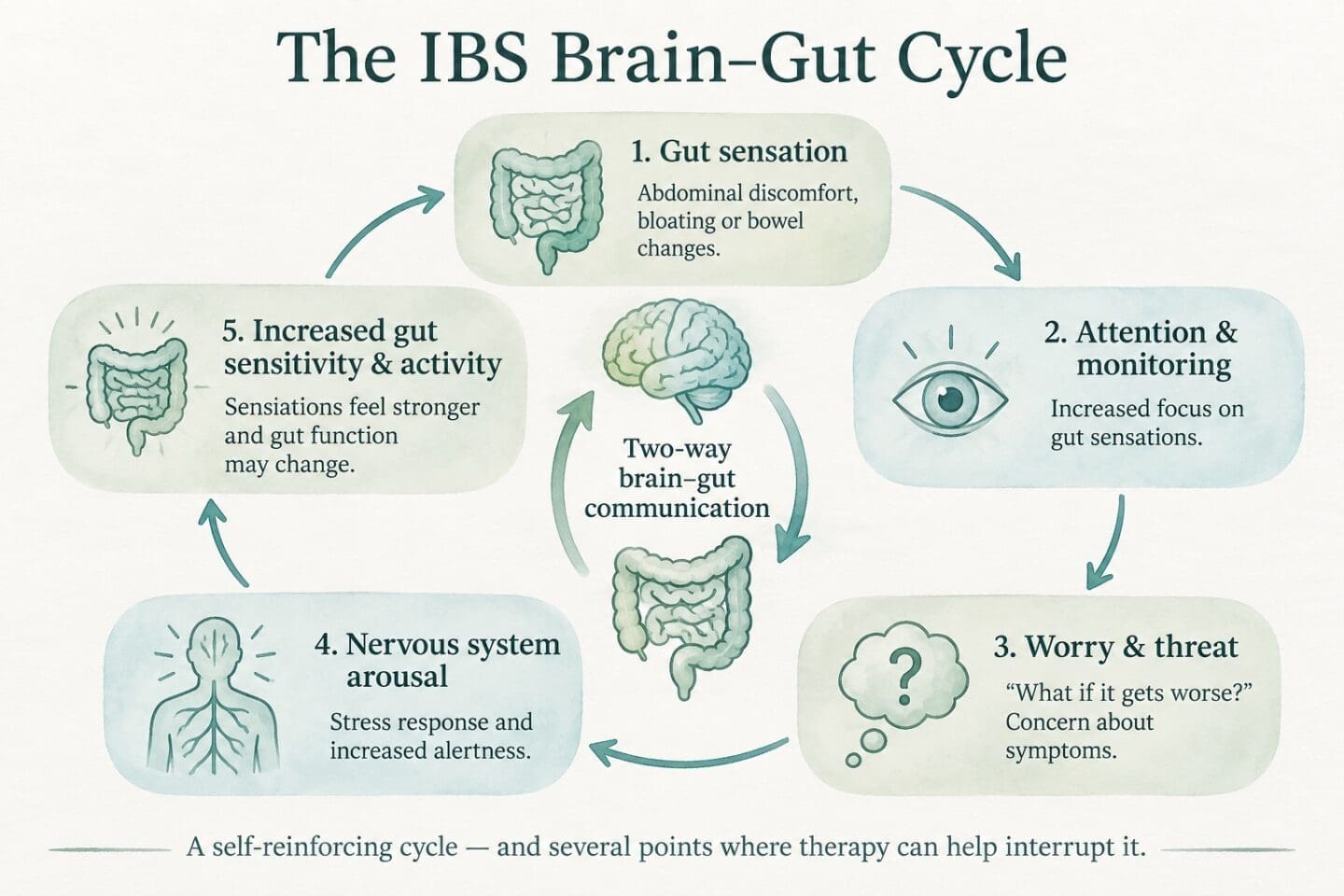
Can IBS Become a Self Reinforcing Cycle?
This diagram neatly demonstrates the interconnection of the brain and gut. Revealing also the inherent vicious cycle.
How Might Gut-directed Hypnotherapy Help?
Research shows that it makes a number of key contributions such as:
- Reducing the intensity of gut sensations and discomfort
- Enables a more regular pattern of bowel activity
- Calms the alarm and fear response to IBS symptoms
- Helps reduce catastrophic predictions about symptoms
- Reduces hyper-vigilance towards the gut
- Identifies safety behaviours and avoidance that reinforce fear
- Uses gradual exposure to help the brain learn that a gut sensation does not always lead to the feared outcome
- Builds confidence in the ability to cope when symptoms do occur
Relaxation can occur during hypnosis, but that isn’t the whole point of gut directed hypnotherapy.
Dr Elena Eliadou, Consultant Gastroenterologist (via Instagram)
What Actually Happens During a Gut-directed Hypnotherapy Session?
Gut-directed hypnotherapy is not simply a way of reducing anxiety. Clinical studies show that it can improve gastrointestinal symptoms, including abdominal pain. It may do this partly by changing how gut sensations are processed, reducing visceral sensitivity and modifying the nervous system’s responses to those sensations.
This is a very important point.
After the initial thorough assessment subsequent sessions will be tailored around your specific symptoms, your priorities and your goals.
A typical programme will involve learning to relax with hypnosis. This has the beneficial effect of calming the nervous system so that you are more responsive to gut-directed imagery and suggestions. For example, for symptoms of burning, cooling imagery might be used. Or for ‘intestinal hurry and urgency’ slow flowing, calming imagery. Similarly for tightness or bloating, imagery of comfort, softening will help and these will all be tailored to your goals.
There will be exercises and practice between sessions. The combination of this gradually changes the way the brain responds to gastrointestinal sensations. Messages of safety, practised regularly will train the brain that these sensations are not danger signals.
A key part of hypnotherapy involves defining the problem and articulating the desired goals. From there we identify the relevant thoughts, emotions and responses to the experience of IBS. Together in session we develop positive alternatives, rehearsing them and practically applying the learning to everyday life.
The Brain Has Remarkable Prediction Abilities
If the brain has repeatedly learned, gut sensation = urgency = danger which then triggers emotions of fear and anxiety, it becomes very efficient at anticipating this sequence.
Hypnotherapy and CBT give us opportunities to test those predictions in a safe way, using the power of the imagination to create new learning. Over time, the goal is for a gut sensation to become neutral information again, rather than an automatic signal that something bad is about to happen.
The fear and anticipation cycle is very real and very strong for those living with iBS.
Questions such as these become major preoccupations. Where is the nearest toilet? What if I need to leave in a hurry? What if I eat this? What if it kicks off while I’m out? What if I have an accident? What if I am too uncomfortable?
Understandably people start to avoid certain activities, certain foods and things they used to enjoy, like going out with friends or exploring new places, travel, holidays etc.
Unfortunately this has unintended consequences as it reinforces the brain’s expectation and prediction that gut sensations are dangerous or unmanageable. Reasonable precautions are often necessary. However, when avoidance becomes increasingly restrictive, it can reinforce the expectation that ordinary activities or gut sensations are unsafe. Therapy can help people distinguish useful practical precautions from fear-driven restrictions that are unnecessarily limiting their lives.
Who Might Benefit From This Therapy?
People with diagnosed IBS, particularly those with:
- persistent symptoms despite conventional treatment
- IBS-D, IBS-C or mixed symptoms
- abdominal pain/bloating
- marked symptom-related anxiety
- fear of eating or travelling
- toilet-related hyper-vigilance
- symptoms strongly affected by stresssignificant disruption to work or social life
Gut-directed Hypnotherapy Alongside Medical Care
Gut-directed hypnotherapy complements appropriate medical assessment and treatment it does not replace it.
As a gastroenterologist and cognitive behavioural hypnotherapist, I don’t see these approaches as separate from gastrointestinal care.
Dr. Elena Eliadou, Consultant Gastroenterologist (via Instagram)
The initial assessment is very important and time is taken during the first session to do this thoroughly. Crucially I will be looking for new or unexplained symptoms. If present, this may require a recommendation to seek medical advice or further investigations.
Gut-directed hypnotherapy complements medical care rather than replacing it. Before beginning treatment, it is important to establish that IBS has been appropriately diagnosed and that any concerning symptoms have been medically assessed. New or changing symptoms, unexplained weight loss, rectal bleeding or other warning signs may require further medical investigation.
Conclusion
IBS can be a distressing and sometimes debilitating condition, affecting far more than just the digestive system. But understanding the two-way relationship between the gut and the brain opens up new possibilities for treatment.
Gut-directed hypnotherapy, combined with CBT, offers a way of working with these patterns rather than simply managing the symptoms. By gradually changing how the nervous system responds to gut sensations, we can begin to reduce fear, build confidence and regain some of the freedom that IBS may have taken away.
As with so many mind–body approaches, change doesn’t necessarily happen overnight. But small steps can lead to meaningful and lasting improvements.

