Clinical Hypnotherapy Explained
Clinical hypnotherapy is a safe, evidence-based approach that uses focused attention and guided relaxation to support meaningful psychological and physical change.
If you’ve ever wondered what clinical hypnotherapy is and how it works, you’re not alone. Many people feel curious—but also uncertain—often influenced by myths or stage hypnosis seen in entertainment.
In reality, clinical hypnotherapy is a collaborative, therapeutic process used to support issues such as anxiety, pain, stress, and emotional wellbeing and positive behavioural changes.
In this article, clinical hypnotherapy explained explores in a clear and practical way how it works and what it can help with.
It also reflects my own journey in understanding hypnotherapy in a clinical setting and demonstrates clinical hypnotherapy as practised today.
A personal perspective
I will freely admit, for most of my life, I have been wary of and simply avoided the whole idea of hypnotherapy. I had not been impressed or convinced by anything I had seen on television or had heard about in the entertainment world. At best it seemed simply a performance or gimmickry, at worse downright fraudulent. However a very good friend of mine, an experienced clinical psychologist, told me how much she valued hypnotherapy in her own practice and gave me examples of some stunning results she had observed with clients. This piqued my interest and made me realise how little I knew about this therapy.
Studying with the UK College of Hypnosis and Hypnotherapy opened my eyes and I made the journey from being very sceptical to completely convinced of its effectiveness. Moreover I have experienced the benefits for myself on many levels. I can truly say this has changed my life.
The history of hypnotherapy and the progression to its place in modern clinical practice
Are you surprised to learn that hypnotherapy was the first and original talking therapy?
Lets dive into the history of this intriguing practice. Mesmerism is the true historical precursor of hypnosis. Mesmer (from where we get the word mesmerised) himself was born in Paris in 1734. He trained in medicine and was influenced by Paracelsus a Swiss physician who believed doctors should treat disorders of the mind as well as the body. He was interested in Newton’s theory of gravity and by Maximilian Hell, a Jesuit Priest, who used magnets, Mesmer called this ‘animal magnetism’. He was drawn to natural healing and used magnets to “draw” diseases out of the body and for healing bones. It was very popular in France in the 18th C. He would ‘hook up’ his patients to ‘baquets’ (magnetically charged drums of water) and induce an emotional crisis. Symptoms were called forth and expelled.
However in 1784 King Louis XVI commissioned a Royal Commission to look into Mesmer’s ‘System of Animal Magnetism’. Historically, this was a very important event, as it was the first ever set of controlled trials. The commission which included Benjamin Franklin, along with other leading French scientists, conducted what would now be recognised as early controlled experiments. They discovered that patients reacted only when they believed they were being magnetised. When magnetism was secretly withheld, the dramatic reactions disappeared. Their conclusion was groundbreaking: the effects were real — but they were caused by imagination, expectation and suggestion, not by invisible magnetic fluids.
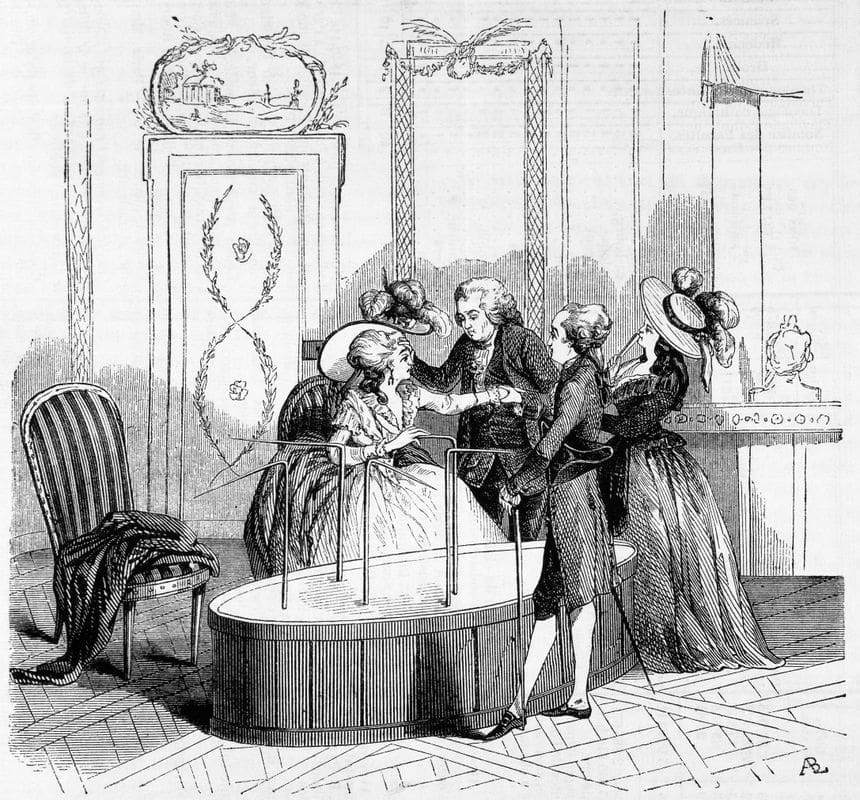
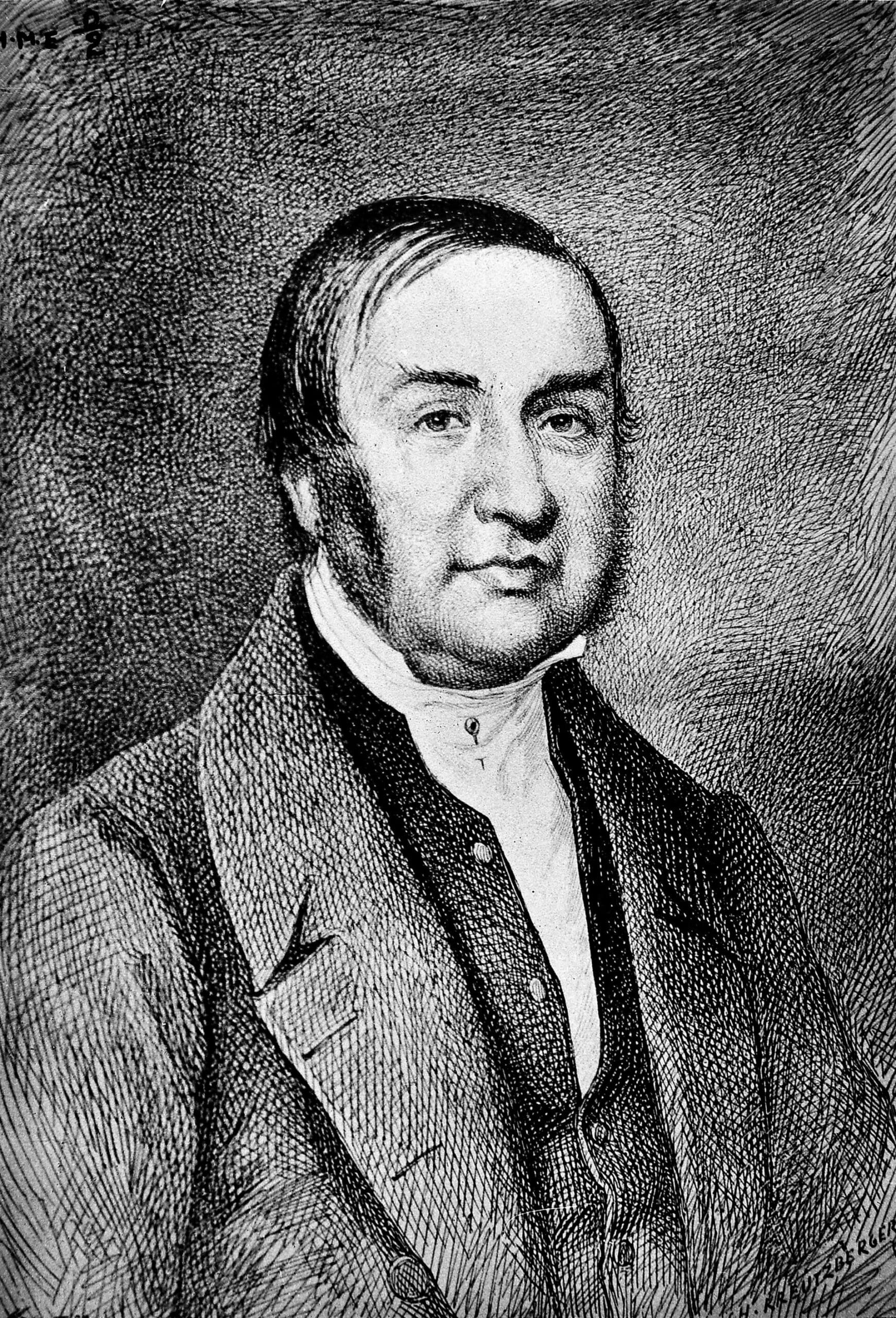
[Left] Mesmer’s Baquet, Paris, 1780s. An engraving depicting Franz Mesmer’s group “animal magnetism” treatments, which helped spark early scientific investigation into hypnosis. [Right] James Braid (1795-1860).
This inquiry became one of the earliest scientific investigations into what we now understand as the power of psychological influence — laying important groundwork for the later development of modern clinical hypnosis.
As a result Mesmerism slowly faded but the influence of its ideas persisted.
The next influential figure is James Braid (1795-1860) who was the originator of hypnotism or often referred to as the ‘Father’ of modern hypnotherapy. Braid was keen to understand what was happening on a physiological and psychological perspective. He was the first to perform ‘eye-fixation’ inductions and practised self hypnosis on himself. He was the first to talk of a ‘sleep of the nervous system’. Braid’s definition of hypnosis was “fixed attention upon a dominant idea with a positive expectation”.
Although Braid coined the term hypnotism, he later felt it was misleading because it implied sleep (from the Greek hypnos).
He observed that hypnosis was not actually sleep, but a state of focused attention; this is one of the best ways to explain clinical hypnotherapy in its current form
Later in his career, he preferred the term “monoideism” — meaning the mind becoming absorbed in a single idea.
This distinction is important for modern clinical hypnotherapy:
- Hypnosis is not unconsciousness
- It is not loss of control
- It is focused attention and increased responsiveness to constructive suggestion
In many ways, Braid’s clarification laid the foundation for contemporary evidence-based hypnotherapy.
The essential features of hypnosis have changed over time. Mesmerism was focused on emotional crisis and sleep. This model relied on ideas of magnetic energy being transmitted to the client. It was very mechanical: total control of the subject and no suggestions given. From the mid 1800’s the focus moved to sleep and later the trance model emphasised sleep, relaxation and depth of trance. Hypnosis is done to the client. Increased suggestibility but mainly sleep and amnesia therapy. Braid and Bernheim were early pioneers away from the idea of a trance. The Ericksonian model emerged next, its key feature was creative trance, bypassing the conscious mind. Also a trance model, albeit weaker, than the previous trance model. The impact is on the unconscious, outside of awareness. This weak trance model of hypnosis persists into the present day. Meanwhile a Cognitive Behavioural Model develops and its key features are suggestibility, focused attention, expectation, imagination. The client is in control; it is a collaborative model. There is no element of the concept or experience of ‘trance’. In this model of hypnotherapy, CBT and hypnosis work together in an integrated fashion.
There are echoes of Mesmerism that remain in the popular consciousness, perpetuated by entertainment and stage hypnosis. These give rise to significant misconceptions about hypnosis. There is a lingering view that somehow hypnosis is a ‘magical’ experience and it retains the aura of mystery. This a direct result of Mesmer’s animal magnetism model. Finally there is a notion that hypnosis is a form of energy therapy, which it clearly is not.
Braid very emphatically grounded his theory on established psychological and physical observations. Braid coined the term “self-hypnotism” early-on and constantly emphasised that hypnotism differed from Mesmerism in this key aspect: it is the client who does all the work, rather than the operator, who merely provides the cues or guidance. For example, many clients are anxious and inhibited because they fear the hypnotist will “control their mind”. This comes from the claims of the Mesmerists to have a telepathy like power over people’s minds, whereas Braid said the client must comply voluntarily and be willing to accept suggestions. Clients fear the hypnotic state may be dangerous or they may get stuck, which comes from the notion of the mesmeric “trance” as supernatural and mysterious. Whereas Braid emphasised the continuity of hypnosis with everyday states of reverie or concentration, and did not use the word ‘trance’ to describe ordinary hypnosis.


Styles of hypnotherapy currently in play: what is modern clinical hypnotherapy and how does it work?
Hypno-analytic therapy started with Freud then was popularised by Dave Elman. It relies on discovering an ‘originating event’, like a childhood trauma, the memory of which is repressed. The therapy uses regression techniques to bring about change through a process of emotional catharsis. This is related to the psychodynamic theory that emotional energy is stuck in the psyche. It uses the inducement of ‘trance’ to ‘access the unconscious’.
There are problems with this approach. There is a great risk of false memory issues, which Freud himself came to recognise and he abandoned hypnotherapy in his ongoing therapeutic practice.
Ericksonian Hypnotherapy is based on the work of Milton Erickson, a hugely influential figure in the field of psychotherapy. He believed that hypnosis is a special type of communication between therapist and client; a direct communication to the client’s creative unconscious which solves problems and comes up with answers. Erickson himself was a particularly charismatic figure and enjoyed good results. However his methods cannot be replicated. He had little regard for the scientific method so there is no evidence base for his methods. Is it hypnosis or direct influence therapy, we are left asking?
There is limited evidence supporting the basic premise of Ericksonian hypnotherapy, and a review of numerous relevant studies by Steven Jay Lynn and colleagues has raised doubts about its plausibility.
“Hypnosis is a social interaction in which one person responds to suggestions offered by another for imaginative experiences involving alterations in perception, memory, and the voluntary control of action.” — Lynn & Kirsch, (2006)
Since the resurgence of hypnosis in the 1950’s there has been much research and investigation into the major controversy within the field as to whether there is a special state of consciousness or hypnotic trance. The roots of Cognitive Behavioural Hypnotherapy are found in Braid’s common sense theory and it is not considered magically more powerful than other therapies. Hypnosis is seen as the art of delivering suggestions, the client does most of the work. The client’s conscious mind responds to suggestions and this responsiveness can be strengthened or modified with skills training. It emphasises continuity with ordinary psychology and uses mainstream psychological concepts and terminology. The central concept is that expectation, attitude and motivation explain suggestibility. Hypnosis is no more dangerous than ordinary suggestion and it is emphasised to the client they only respond to suggestions that they agree with. So, hypnosis works in a similar manner to CBT. It is backed by huge amounts of research with a strong evidence base. The neurological evidence supports the ‘non-state theory’ as brain scans reveal the changes happening under hypnosis are task specific and do not show uniform markers of hypnotic trance.
Many researchers and theorists have come to consider this unnecessary to achieve hypnosis. The motivation to settle this controversy has given rise a great deal of research and thus to a much greater understanding of hypnosis.
Healthy scepticism: corroborative evidence for clinical hypnotherapy
A key principle of Cognitive Behavioural Hypnotherapy is one of healthy scepticism: if we don’t have corroborative evidence for an approach then we don’t use it. Evidence in this context is defined as being based on experimental research (how hypnosis works) and clinical research (what it works for, what can be treated).
Repeatability is a necessary feature of good research. The benefit for therapists and clients is that they work with the confidence that this particular method or technique has been proven to be effective in many contexts over time. There is much ongoing research on Hypnosis: 7 research labs in major Universities in the US, London, Australia; 3 dedicated research journals; regular articles in other journals; ongoing clinical and experimental research.
In the twentieth century, researchers such as Theodore Xenophon Barber argued that hypnosis should be examined using the same standards applied to all areas of psychology: clear definitions, controlled experiments, and repeatable findings.
Rather than assuming hypnosis was a mysterious altered state, Barber proposed that hypnotic effects could be explained through ordinary psychological processes such as: Expectation; Motivation; Focused attention; Imaginative involvement
His position strengthened the scientific credibility of hypnosis by insisting that:
- Claims must be testable
- Results must be replicable
- Explanations must be grounded in observable psychological mechanisms
This sceptical approach did not dismiss hypnosis — it helped move it from the margins of medicine into mainstream psychological science.
“Hypnosis must be studied with the same experimental controls and standards of replication as any other area of psychology.” T X Barber – 1969
The Royal Society of Psychiatrists reports that research shows many psychiatric conditions can be helped by Hypnotherapy: PTSD, depression, anxiety, insomnia, eating disorders, memory improvement after brain injury. Likewise, medical conditions such as pain, medical / surgical procedures, cancer treatment side effects, anaesthetic procedures, burn wound care, dental procedures, childbirth, menopausal symptoms, skin disorders etc. A search on PubMed reveals over 16,000 hypnotherapy related research articles.
A deeper look at at explaining clinical hypnotherapy?
Clinical hypnotherapy is a structured, evidence-based psychological approach that enables focussed attention and depth relaxation in order to help individuals change unhelpful patterns of thinking, build emotional resilience and change behaviours that keep them stuck.
At Clear Spring Therapy, clinical hypnotherapy is delivered as Cognitive Behavioural Hypnotherapy (CBH) — a modern integration of cognitive science and therapeutic hypnosis. This approach is grounded in well-established psychological models showing that thoughts, emotions, physical sensations and behaviours interact in predictable cycles.
Clinical Hypnotherapy works by using guided therapeutic hypnosis to help clients enter a focused, absorbed state of attention. In this state, the mind becomes less distracted and more receptive to constructive learning.
Clients remain fully aware and in control throughout. Hypnosis is not about being in a trance or any loss of control. Instead, it is a state of heightened concentration — similar to becoming absorbed in a book or film.
Within this focused state, clients are better able to:
- Identify negative automatic thoughts
- Challenge irrational or unhelpful beliefs
- Reduce emotional reactivity
- Install balanced, flexible thinking patterns
- Rehearse coping strategies
- Strengthen calm and self-confidence
Cognitive behavioural hypnotherapy follows a structured therapeutic process.
Some of the steps in the process may include the following:
- Assessment and collaborative goal setting
- Education and skills training: understanding how thoughts, emotions and behaviour influence each other, e.g.
- Identifying negative cognitions and unhelpful patterns
- Cognitive disputation and restructuring
- Installing healthier beliefs with hypnosis
- Rehearsing coping strategies and behavioural changes
- Generalisation into everyday life
- Relapse prevention and resilience building
Hypnosis enhances the depth of cognitive restructuring by increasing concentration and emotional learning. This makes new perspectives feel more natural and easier to apply in real situations
Is hypnotherapy evidence-based?
In order to accurately explain clinical hypnotherapy one must refer to the many decades of research. The Cochrane Collaboration has reviewed the use of hypnotherapy for several conditions.
For example: Hypnotherapy for pain relief; Hypnosis for irritable bowel syndrome; as part of other Psychological therapies for insomnia. Cochrane reviews are widely regarded as the gold standard in evidence-based healthcare.
Research studies summarised by Nash (2001) indicates that hypnosis can enhance the effectiveness of psychotherapy, with individuals receiving CBT combined with hypnosis showing greater improvement than those receiving CBT alone.
Montgomery et al. (2000; updated analyses since)
Meta-analysis of hypnosis in medical procedures found:
- Significant reductions in pain
- Reduced anxiety
- Reduced medication requirements
These findings support the principle behind Cognitive Behavioural Hypnotherapy: hypnosis strengthens the impact of structured cognitive and behavioural interventions rather than replacing them.
Hypnotherapy for pain relief, anxiety and other medical conditions
See also my article: Hypnotherapy for Pain Relief: A natural Way to Manage Pain
Clinical hypnotherapy can support individuals experiencing:
- Pain management and recovery from injury
- Anxiety and stress-related difficulties
- Panic and phobic responses
- Insomnia and disrupted sleep patterns
- Low confidence and self-doubt
- Emotional avoidance patterns
- Performance anxiety
- Palliative Care suport
- Dental Procedures
- Childbirth
- Pre and post operative recovery
Clinical hypnotherapy is not about dramatic breakthroughs or sudden transformation. It is about understanding how your mind works, interrupting unhelpful cycles, and rehearsing healthier responses until they become second nature.
Change happens through small, consistent shifts — strengthened through focused attention and guided practice.
No big leaps. Just small, steady steps towards clarity, calm and confidence.

Like stepping stones across a river, clinical hypnotherapy explained

